Updated April 21, 2026 12:50PM
The Race Director Who Revived Grassroots Tri When the “Lights Were Going Out”
Cal Tri founder Thom Richmond is building the sport back up - from the bottom up. From $85 flat fees to teachable moments instead of penalties, Richmond’s inclusive formula aims to save grassroots triathlon in the United States.
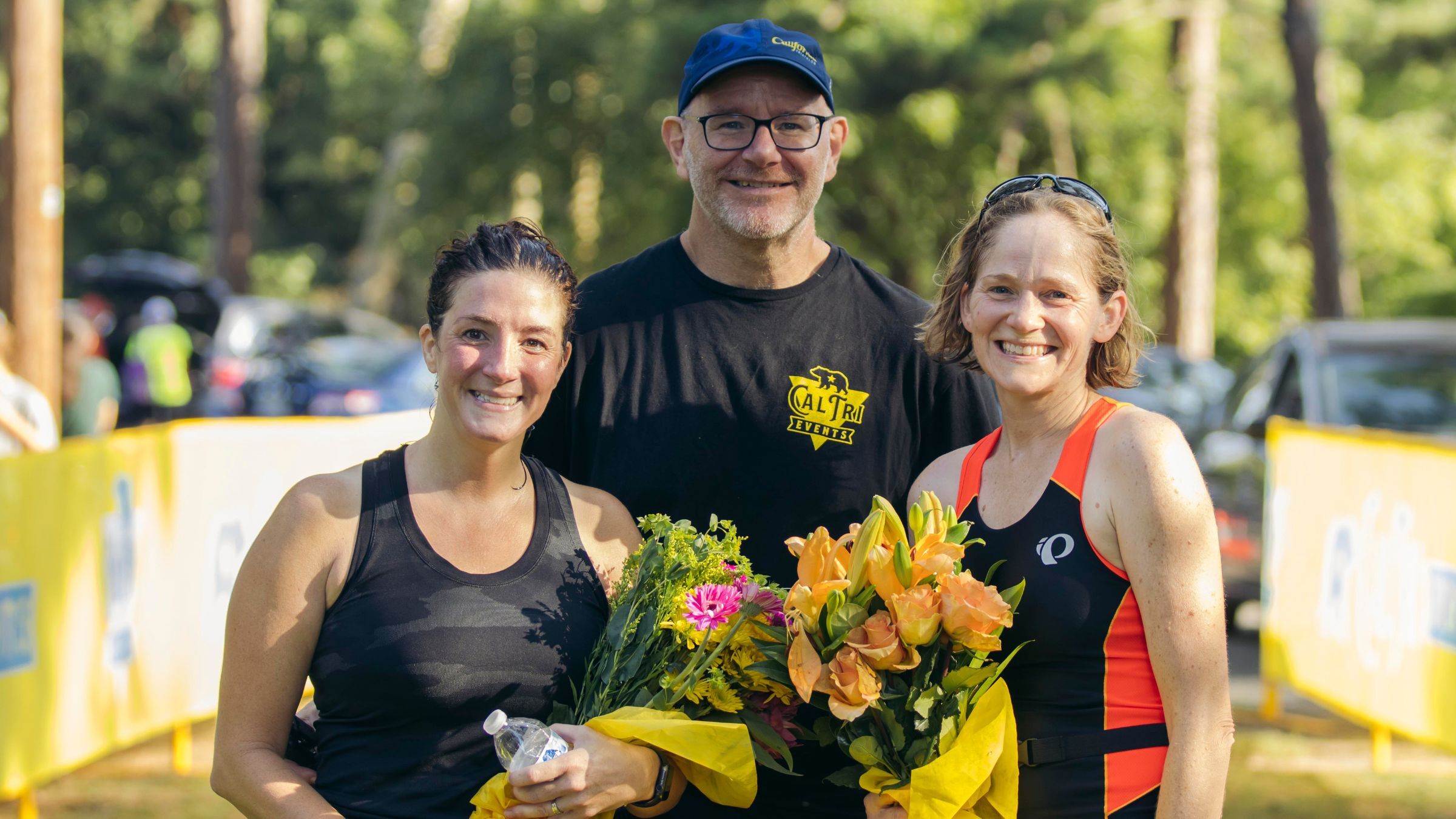
Thom Richmond founded Cal Tri at a time when grassroots triathlon was struggling. His model is a novel concept in bringing a community focus back to the sport. (Photo: Courtesy of Thom Richmond)
When Thom Richmond received a request to be the focus of a profile piece for Triathlete, he says it had him reaching for the sick bucket.
Richmond doesn’t want to be the center of attention. He says when he finishes his work with Cal Tri, a low-cost events business that now welcomes 10,000 entrants each year to swim, bike, and run races, his goal is to collect his packet as an athlete on race morning and have no one recognize him.
The founder’s strategy for immersing himself in the business of endurance sport includes a continuity plan so that what he’s helped build will prosper long after he bows out.
When that time comes (currently scheduled for 2028: “My job is to get our younger race directors up to speed”), his peers will be sad to see him go. From shared equipment to shared sponsorship dollars, he is instrumental in helping independent events work together to provide a better product.
ADVERTISEMENT
And as for the athletes, Brigid Freyne, a 55-year-old rheumatologist in the Temecula Valley, made her view clear. “With every race he organizes, Richmond proves that the sport can grow without losing its soul. Cal Tri isn’t just another race series – it’s a movement toward a more balanced, athlete-friendly future for triathlon in America.”
In contrast, his relationship with the sport’s national governing body, USA Triathlon (USAT), creates friction. In the past, Richmond has called them out on what he believes is a “poor strategy” to grow the sport, criticizing the organization of only promoting races it sanctions and accusing them of profiting unfairly from the one-day license.
“I look at the NGB as an old girlfriend,” he says. “I haven’t used you since 2017. Instead, my job is to do storytelling about all these great [independent] races that exist that have been suppressed.”
ADVERTISEMENT
There’s no doubt Richmond’s low-cost vision for triathlon isn’t shared by everyone. There’s also no doubt that he’s shaping the sport. By the time he does walk away, Richmond hopes to have given integrity to the overused maxim “athlete-first,” having developed races he believes buck the trend on how for-profit events are typically run, and provides the antidote to a money-seeking culture he encountered when moving from rugby to triathlon in his late 30s.
“I’ve seen triathlon change lives”
A former marketer at Walt Disney, Richmond is a storyteller. Rooting his arguments in data, he enjoys metaphors to land his points. Consistently, he returns the focus to the Cal Tri model, whether it is low-cost entry, a generous refund and deferral process, the opportunity to race free for life if you complete 25 events, or the willingness to collaborate with other independent race directors on everything from safety planning to bringing on non-endemic sponsors.
There are shades of former Professional Triathletes Organization (PTO) chairman Charles Adamo here. Adamo, a private man who shunned the spotlight, presented a compelling case for why professional triathletes weren’t being justly rewarded for their endeavors, and how the nascent PTO would address this. Adamo left the post in 2022, but at least part of his vision is still being realized today.
ADVERTISEMENT
Richmond’s version swaps the professional for the amateur side of the sport with the same air of philanthropy; like Adamo, he insists it just makes good business sense. If Adamo was trying to harness top-down inspiration to grow triathlon, Richmond wants to build it from the ground up: The full-time rheumatologist caring for 35 to 40 patients a day and looking to rejuvenate on the weekend; the individual struggling to get off the couch for myriad reasons; the hard-pressed family who can all race together, with the kids taking part for free. “I think triathlon is magical as a place where there can be community,” he explains. “I know it sounds schticky, but I’ve seen it change lives.”
The case for an athlete-first movement
Richmond says his upbringing was humble, quips that his parents would need a co-signer to pay cash, and extends his gratitude to the soccer, football, baseball, basketball, and rugby coaches who gave their time to allow him to participate.
Triathlon came with the familiar newcomer’s tale of being gripped by multisport, but at the same time, missing the locker-room culture of team sport. “The difference between triathlon and rugby was that as captain of the rugby team, I’d want to teach the new players all I knew. In triathlon, it felt as if there was a line of triathlon coaches looking to monetize me.”
ADVERTISEMENT
Instrumental in a training group in California that sent hundreds of athletes to Ironman races, Richmond began questioning what he saw in the sport. He points out that the average Ironman household annual income is almost $250,000, whereas the average U.S. income is closer to $60,000 per year. He wondered: where were the affordable race options?
“As a fairly successful business guy, I found a sport I really liked, and I want that same opportunity for lots of other people,” he says. “That’s the DNA of why we do what we do.”
Cal Tri currently has 18 events with an expected 10,000 athletes in 2026, making it the biggest national short-course series, with multiple races in every US time zone. Registrations were up from 7,000 in 2024 to almost 9,500 last year, with early bird prices at a flat fee of $85 with entrants allowed to defer until midnight before the race for free (Richmond estimates 20–25% of sign-ups have used this policy), a refund check in the mail for an Act-of-God cancellation, and kids allowed to race for free. Unsanctioned by USAT, he acts as a broker for insurance that he states costs him $4.33 per athlete, built into the entry fee without markup.
“It’s a zero-profit business for us,” he says. “We’ve never made a cent.”
ADVERTISEMENT
Affordability and accessibility in triathlon
There’s no obsessing over illegal shoe stack heights or disqualifying athletes who shove water bottles down their trisuits for aerodynamic gains, or spending cash on anti-doping policies, for example. In fact, even if someone rides over the GET OFF BIKE line (Richmond prefers simple language, saying “We call it swim-run, not aquathlon. Nobody has to learn Latin”) coming into transition, it’s not seen as a penalty, but a teachable moment.
Due to his wife’s work, Richmond lives on a college campus at Washington and Lee University in Lexington, Virginia, where he says there’s a bond of trust for people to do the right thing. He likens that to Cal Tri races.
ADVERTISEMENT
“We don’t even own a podium,” Richmond says. “It’s stripped down. There are only three hard rules. You can’t abuse a volunteer or police officer. You can’t cross the double yellow line on a bicycle. And you can’t wear headphones. Break one of those, and you’ll be asked not to race the series again.”
It is still a race. There’s a chip timing mechanism, a results sheet, and set distances to compete over, but it is seen as less pressurized. Richmond says that draft packs on the bike where riders can gain an illegal assistance, for example, don’t really factor at these events, and athletes aren’t striving for Kona qualification (or short course age-group qualification given races they are not USAT sanctioned), but are more likely to spend 90 minutes at a swim clinic the day before to calm nerves before tackling the open water.
Redefining rules and trust in racing
His mission is to make the independent race sector thrive. To further this goal, he recently purchased race search engine TriFind, which currently lists more than 14,500 races in the U.S. (40% of which are unsanctioned). Richmond likes talking about collaboration rather than silos, and from his perspective, the approach is working.
“Cal Tri Events’ double-digit growth is happening in a market where USAT-insured race finishers were down 3%, Ironman 70.3 finishers were down 7.5% (on repeat events), and Ironman 140.6 finishers were down 5%. It’s a good story. The question is why?”
ADVERTISEMENT
Richmond backs this up by providing spreadsheets linking to Ironman’s official results pages for the U.S. market, with USAT confirming at its annual Endurance Exchange conference that adult participation was down 3% or around 9,200 in real terms.
All of Cal Tri’s races are short-course – or, as he prefers to call it, “fast course” – and all allow athletes to change distances within the same event for free, whether dropping down or scaling up. Richmond rationalizes this by saying that four times out of five, athletes drop down in distance due to injury or lack of conditioning, so Cal Tri is happy to accept a relative handful of others moving the other way.
As the leader of the non-profit, he takes a $100k salary, introduced three years ago because he says he was attending events for 20 weekends a year, and the board wanted to put a value on the role. It recruits differently from other organizations, too, persuading high-performing individuals to commit to pro bono hours. These include Rollin White of Diversified Technical Systems, Inc., Kim Degen of Taco Bell, Anthony Grey of the MBA UCLA Anderson School of Management, and Les Borsay of the J. Paul Getty Trust.
“If we didn’t have the mission, I couldn’t get the CEO of a $35 million company to be involved with us for the past 12 years,” Richmond explains. “We’re getting folks who make $250k to spend their non-profit time, their charity time, with us.”
ADVERTISEMENT
He says many volunteers have been with Cal Tri for 15 years. “The model has always been safe, affordable, and accessible, and everyone in our leadership is either a current multisport athlete or was. I had a conversation with a race director [from another organization] the other day. They were like: ‘If they change their race, we make money. If they want parking, we make money. If they want to pick up the packet the morning of the event, we make money. If they want to come to the clinic, we make money.’ But that’s not our way. Everyone in our space is an athlete, and we don’t look at that person as a way to make money. There is no nickel-and-diming.”
While Richmond is successfully securing non-endemic partnerships with sponsors like La Crema Winery (who will serve as title sponsor for the late-June Guerneville, California, race), he finds greater fulfillment in the synergy between grassroots events.
Beyond launching a new race director conference later this year for networking and resource pooling, he leads through practical collaboration. A prime example occurred after he acquired the Oro Valley Triathlon in Arizona; Richmond took the $3,000 worth of transition racks from that deal and arranged to lend them to the popular Houston Kids Triathlon event. That race is managed by Negative Split Productions in Texas, a firm led by Tony Sapp that also handles timing for most Cal Tri races. This level of mutual support among independent organizers perfectly illustrates the collaborative spirit Richmond aims to foster.
He says eight of the 18 events are held at locations where triathlon had “disappeared or was going away” because of decreased athlete demand or operators leaving the sport for a variety of reasons. This includes Lake Perris, Ventura, Castaic Lake, and resurrecting the fortunes of the Newport Dunes Triathlon that first ran in 1978, a sentiment echoed by long-time endurance sport interviewer and media personality, Bob Babbitt.
ADVERTISEMENT
“The first time I went there, it was around 400; now it’s 1,800–2,000 participants,” Babbitt says. “I just liked that Thom was investing in the future of the sport, and that’s something all of us need to do.”
There is mutual respect between the two men (Richmond refers to Babbitt as the Mayor of Tritown) who have known one another since Richmond put on a first event, the Trick or Treat Tri, at the Santa Fe Dam on the outskirts of L.A. on Halloween weekend.
“I liked what he did, it was simple,” Babbitt continues. “During that era, things were becoming very Ironman-centric, but a lot of short-distance races were going away, signalling a downturn in the sport in the U.S. Look at finisher numbers from 2011 to 2023, something like 565k finishers in USAT-sanctioned events to just over 300k finishers – that’s substantial.” Babbitt’s concern was that if dominated by Ironman, the sport would become just a “bucket-list item.”
ADVERTISEMENT
“Hire a coach, spend six months training, get the M-Dot tattoo on my calf, and move on to something else. I never felt that was sustainable,” Babbit says. Instead, he welcomes Richmond’s no-frills approach to being a short-course race director, in what he views as an often thankless task.
He points out a contrast between the welcome and support Ironman can receive from regional governments as it brings in sporting tourism, and what he calls the “pain in the ass” perception of short-course races that inconveniences local residents.
“When events like Ironman bring in a revenue stream, it’s treated differently,” Babitt argues. “Because they are being paid to bring events to La Quinta [for example], now you’re going to get help with fire service and police and all the rest of it, because they are a partner. They want you to be successful.
ADVERTISEMENT
“For other race directors, it’s going to cost you X to use the bay or Y to use the grass. They don’t give you anything, because they can’t quantify whether you’re filling up hotel rooms or not because you’re a local event. They know with [Lake] Placid, Ironman has people coming in for five days spending money, and that’s how they rationalize paying for the longer distance events, but it doesn’t necessarily transfer to the shorter events. Yet Thom is all in on the short distance, and I respect the hell out of that.”
Before he steps back from the role, Richmond wants to actively help other organizations adopt the Cal Tri model.
“We as a non profit have a cashflow position that is so enviable, we’re sitting on over $500,000 doing nothing except earn interest,” he says, “This model I’m talking about, the person who leads it can make $100k, we have lots of money in the bank, all our equipment paid off, we’re growing the sport. I would think if you found 10 of us with 10,000 registrations, that would be growth.”
ADVERTISEMENT
He aims to share that success by offering incentives for race directors who start or revive local events: “We’re going to have a scholarship for new races. If you start a new race, we’re going to give you a $500 credit at TriFind, our advertising and marketing platform, and give you a race director mentor who will help you get your race off the ground with promotion, planning, and production at no cost. We will expose you to our traffic control engineer, who is going to give you a better deal than I get, so they can help you make it safe. We’re going to help grow the sport by investing in the sport.”
Collaboration, not competition, for growing triathlon
One champion of the Cal Tri model is Camille Baptiste from Austin, Texas, who describes herself as “a 50-years-young Caribbean African American female who still gets energized by every finish line smile on race day.” She’s found a place to belong in the Cal Tri ecosystem as the series’ southwest race director, and is paying it forward through the inclusive practices Richmond has established.
“I’ve always believed triathlon should feel accessible and exciting, whether it’s your first race or your 50th, and this role allows me to help deliver that experience across a broader region,” Baptiste says. “Our free race-week swim and transition clinics are real ‘golden nuggets’ – they help bridge the gap for new athletes entering the sport and for those navigating their first triathlon. For many, that’s the moment triathlon shifts from intimidating to possible.”
A quiet revolution with big impact
Baptiste says she initially connected with Richmond while aligning race calendars to better serve the Austin triathlon community, making sure athletes had more opportunities to participate without conflicts.
ADVERTISEMENT
“Behind the scenes, Cal Tri is highly organized and built in a scalable way, which creates strong continuity across the race series,” she continues. “That consistency really matters for athletes who participate in multiple events nationwide – they know what to expect and can focus on their race experience.”
Those athletes include Freyne, who says she has raced nearly every other weekend for 45 years, but looks to have a clear favorite.
“I’ve seen just about every kind of event imaginable,” she says. “But Cal Tri stands apart – not just for affordability and safety, but for the personal touch Thom brings. He’s approachable, visible, and genuinely invested in ensuring every participant – from first-timers to veterans – feels welcome and valued.
“Weekends, for me, are about rejuvenation and health. Thom’s races make that possible. I don’t need to worry about traffic hazards, confusing routes, or missing results. Everything runs with precision and professionalism. In an era when the triathlon world has become increasingly expensive and restrictive, Thom Richmond has quietly ignited a revolution.”